 China AI Hub
Technology / Mixture of Experts
Mixture of Experts
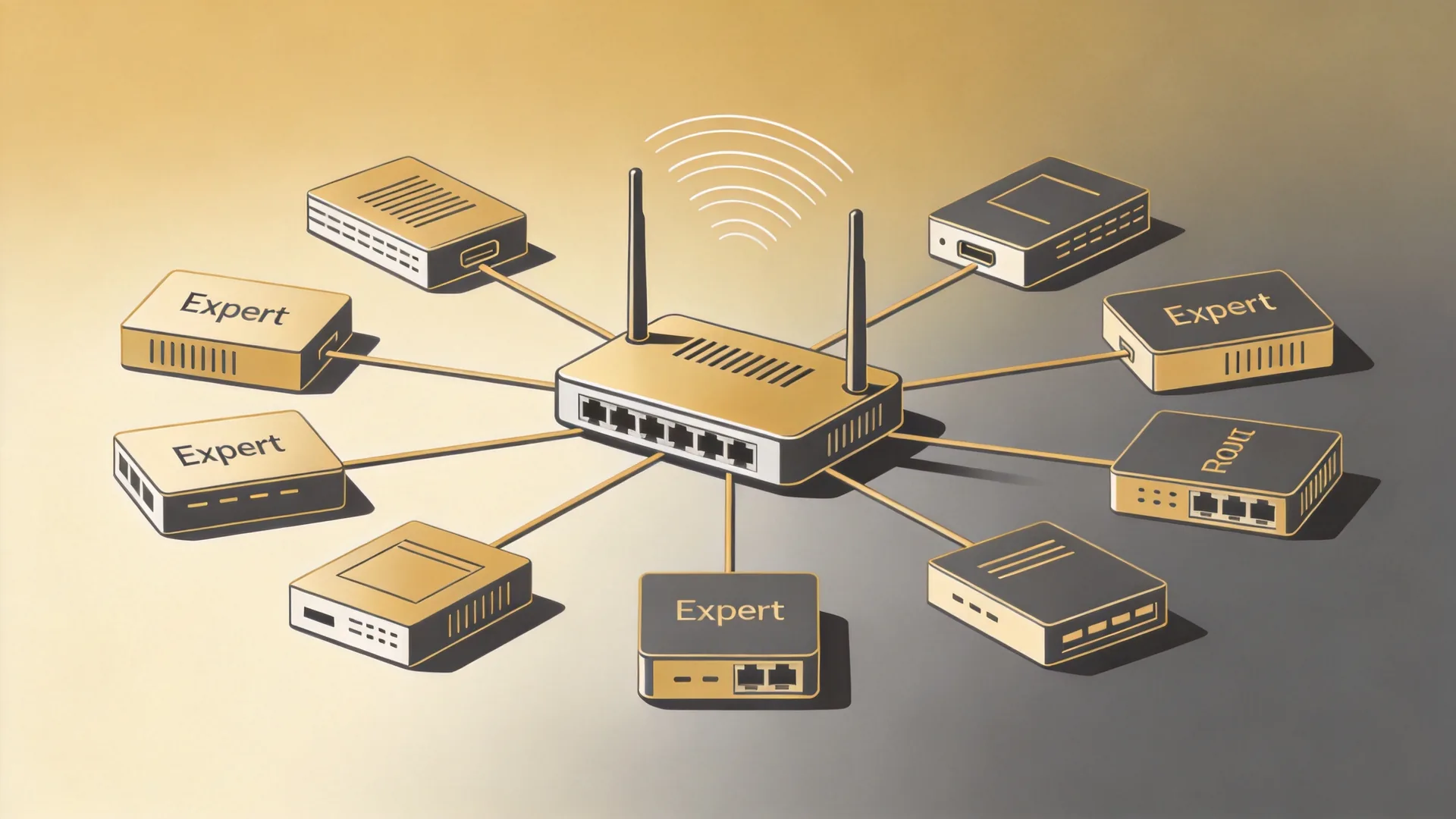
Mixture of Experts (MoE) is a model architecture where each layer contains many small 'expert' networks and a router activates only a few per token, so total parameters can scale up while per-token compute stays roughly flat.
Technical background
MoE dates to the early 1990s and was revived for deep learning in 2017 by Shazeer et al. at Google. It became central to large language models when DeepSeek-V2 (2024) demonstrated an economical open MoE design that served as the basis for many subsequent Chinese open models.
How it works
A sparse MoE transformer replaces the feed-forward network in each layer with N experts (each its own FFN) plus a router that scores tokens and picks the top-k experts per token. Total parameters include all experts, but only k experts run per token. The router is trained jointly, with load-balancing losses to avoid expert collapse.
Why it matters
MoE decouples capacity from compute: a 2.4-trillion-parameter MoE can run with roughly the cost of a dense model an order of magnitude smaller. This is how several Chinese labs reached frontier capability while underlining cost efficiency. It does, however, concentrate memory requirements — all experts must be resident in memory (GPU or CPU offload).
Chinese adoption
MoE is widely used across the Chinese open-model ecosystem. Alibaba’s Qwen line is the clearest public example: Qwen3.5 ships MoE variants such as 397B-A17B, 122B-A10B and 35B-A3B (the A suffix denoting active parameters), and the current Qwen3.8-2.4T-A95B open release continues the pattern. DeepSeek’s architecture work on economical MoE training is documented in the DeepSeek-V2 paper.
Major Chinese companies and models
- Alibaba Cloud (Qwen) — Qwen3.5 MoE family (397B-A17B etc.) and Qwen3.8-2.4T-A95B (open weight, custom MIT-style license).
- DeepSeek — DeepSeek-V2 introduced the economical MoE design widely adopted afterward.
Practical applications
Frontier-scale language models at reduced serving cost, dense-tier replacements in latency-sensitive pipelines, and the base architecture behind several flagship reasoning models.
Limitations
High memory footprint for serving (all experts resident); routing can be unstable under distribution shift; and MoE models are harder to fine-tune and quantize well than dense models of comparable active size.
Deployment considerations
Plan memory around total parameters, not active parameters. Use MoE-aware serving stacks and vLLM-class runtimes that offload idle experts. Verify quantization quality on MoE specifically, since router and expert quantization interact.
Future development
Deeper integration of sparsity with attention (e.g., MiniMax’s MSA sparse-attention work), expert specialization, and MoE-aware compression continue to develop. Treat sparsity claims as architecture details, not quality guarantees.